







Can I be the new Slowhand?
I have very little musical talent. I can occasionally rock a karaoke microphone and can tap out a beat on a simple set of drums, but one would never confuse me for a member of the band. (A roadie possibly, but I’m working on my weight now.) Well, something magical is coming that may one day propel me into the ranks of the amateur musician. This magical device, Ubisofts’ Rocksmith.
Last year at PAX Prime 2010, a rumor circulated with the release of Rock Band 3. This rumor was that they were developing an interface that would allow you to use an actual guitar to play the game. As this happened, it would teach you the notes, chords and basics you would need to play your favorite songs. This sounded great for a few reasons. First of all, I already own Rock Band and Rock Band 2. It’s an interface I’m familiar with. I know how to navigate the menus and when to press the

Hi, Farva-bear!
appropriately colored button with the appropriately timed strum. There would be a very small learning curve when it came to the interface itself. Secondly, the expected price-point was what I considered to be fair and balanced. If you already owned the game, an additional (estimated) $250 would net you a functional guitar that would interface with my Xbox 360 (or PS3) and could be plugged into a regular amplifier for offline play. Lastly, it would teach my no-playing ass a skill that helps you pick up dumb chicks at parties. Sadly, after a year no such thing has come to light. No guitar, no interface and no dumb party girls.
With all this in mind, I admit I was skeptical when myself and Nerves passed a booth that looked like multiple mini-recording booths in it. He noticed before I did that the guitars being played had six-strings and no colored buttons. This was enough to get us both in line (him for the music and me to be closer to him.) As we got closer to the front of the line I got to talk to one of the developers of the game. I explained how I was rather tentative after last year’s guitar-dreams never coming to fruition. He explained that what has being done here was better than anything Rock Band could have done. Rock Band was trying to get a guitar to work with their pre-built interface. Ubisoft, instead, looked at the guitar and built an entire interface around it. Sounds simple enough, but I’d soon see once my hand gripped the neck of the pretty red Fender in front of me.
As soon as Nerves and I entered the booth, the guy demoing the game informed us that it needed to be reset. The game is rather intuitive and builds upon your earlier play. As people played and got better (they were in the booths for anywhere between 10-15 minutes) the game was learning how good they were and adjusting the difficulty. While doing this, he showed us some of the things in the menu that are there to teach you how to play the guitar. The first was a game called “Ducks”. Simply put, it showed all of the frets and their individual numbers on the screen. A duck would appear between one of the frets and your job was to hold down that fret and pluck the first string. Doing so would shoot said duck. This would continue until the time was up and, if your score was high enough, the next round would continue a little faster. The idea is to teach you the fret positions so when you’re playing a song and it says to hold fret “8” and strum the second string, your hand goes there automatically. Not a bad way to get a guy like me playing.
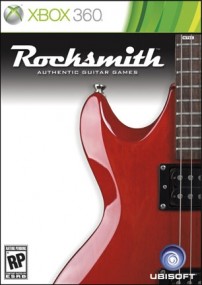
Is this your next obsession?
Another thing he showed us was the “medal system.” This was like a tutorial area that started with single notes. It progressed to scales, chords, power-chords and much more. The list looked to be about twenty to thirty items long. As you start the first one, it teaches you how to play individual notes. At the end of the exercise you are graded and given a medal. All gold means you’ve pretty much mastered that exercise and are better equipped to move to scales and the lot.
At last we get to the interface itself. I’m not going to lie to you, it’s a bit confusing. The strings are color-coordinated and the frets are numbered. What you end up with is a horizontal six-string mass moving back and forth, and another vertical table moving top to bottom. At first it looks like Rock Band or Guitar Hero on crack, but as you begin to play the simplicity and genius of the set up stands out. Since I’m a beginner, I thought it would be overwhelming. Instead, I found it to be fun, intuitive and incredibly responsive. I know my description of the interface seems confusing and I recommend that you visit this link (CLICK ME!) and view the actual commercial. It shows the interface during the entire two minute presentation and it is beautiful.
After all this, the question you should be asking is “How much will this cost me?” If you do not own your own guitar (like me) then you’re looking at a $200 price point. This comes with the game, the guitar and all the cords needed to interface with your gaming system of choice. If you already own a guitar, it’s a mere $80. Honestly, I was excited about spending $250 on a guitar to interface with the Rock Band 3 I’d already purchased. This is a screaming deal, as far as I’m concerned.
As a note for all of you Bass players out there (Captain Nerves, I’m looking at YOU!), they have already begun work on a Bass version of this game. It’s not clear whether it’ll be a DLC or a Disc-based game, but it’s a reason to expand what is already a fantastic gaming experience. Usually I’m not a huge fan of learning while I’m gaming, but this is something special. Preorders are being taken now and an October release is expected. Don’t miss out on this one.
Pingback: author()