






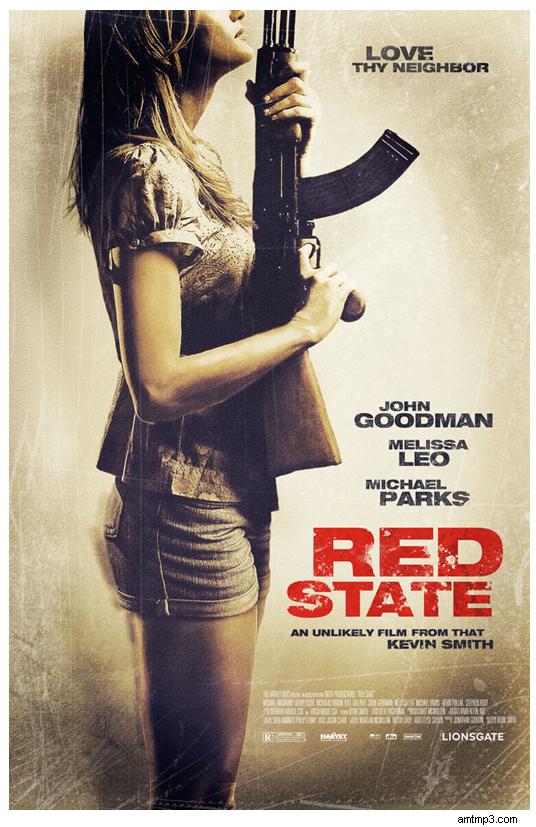
Kevin Smith's Red State
I have always had a special place in my heart for Kevin Smith and his films. Sure, as I’ve aged that spot has been relegated to a dusty, forgotten closet loaded with my old He-Man toys, but he’s in there somewhere none-the-less. I’ve followed his sojourns recently into podcasting, flight troubles, and his emergence at the recent Sundance where he touted his decision to take his newest movie, Red State, on the road instead of putting it through the normal theater circuit. I wasn’t very heartened to hear him state the reason he was doing this was because he didn’t think the movie would do well in the normal system. My first thought was that he was saying regular people wouldn’t “get” his newest movie, which is a grandiosely pompous way of convincing yourself that your shit don’t stink, but since this was Kevin Smith, an endlessly self-effacing man who wears his self consciousness out in the open like a pair of ill-fitting shorts, I reckon he really means what he’s saying: Red State would have tanked in the theaters. Does this mean he thinks the movie sucks? Or does it just mean he accepts that what he sees as quality does not register at the same level with the average person. Well, today I get to find out for myself as Red State has made it’s way to Netflix Instant! Come along with me as I take in what Smith promises is his second to last movie.
This movie doesn’t waste any time! The name of his production company, The Harvey Boys, flashes right before the title and then we are immediately in the car with Travis, a tardy student being driven to high school by his mom. This guy’s supposed to be in high school? He’s got more wrinkles than my balls! His two friends look a bit younger, but the one sporting a rat tail and mouthing his dialogue like Elmer Fudd’s half wit brother looks damned ridiculous. I guess all that’s beside the point though, since these guys are delivering Kevin Smith dialogue better than most of the actors in his movies.
Smith has a terrible time writing dialogue. In most of his movies he can’t help but plug his wit into the mouths of every willing actor that stumbles to the plate. It is a distracting mess of words that take a few seconds to process before the joke settles in your brain just as the second character in a scene mumbles out another equally jocular line. It is fun to watch, especially if you’re a fan of dick jokes, but it is a constant reminder that you are watching a movie written by one person. And that person doesn’t know how to speak in anyone’s voice other than his own. Here, at least so far, we’re getting juvenile dialogue, but it feels appropriate as it is spoken. This is a huge improvement over Smith’s past works, and I’m happy to see this evolution in his style.
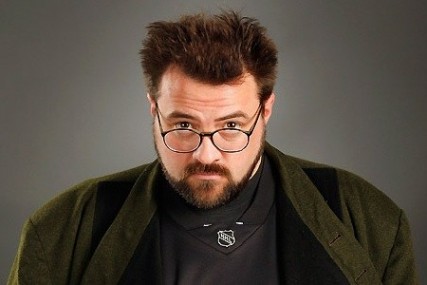
Dick joke dick joke dick joke dick joke dick joke insert here.
The three main teens are looking for sex, and the internet promises easy rewards with a site filled with girls promising they are ready and willing. While most of the women live in Los Angeles and New York, one of them happens to live in the nearby town of Cooper’s Dell, which is also coincidentally the place where a group of gay-hating church members (a copy of the real life Westboro Baptist Church group) reside. It is in Cooper’s Dell that they meet their soon to be lover, played by Academy Award winning actress Melissa Leo.
I don’t think I’m giving much away in terms of plot details to tell you that the boys’ trip to Cooper’s Dell isn’t going to end up with them driving home smoking a cigarette and high fiving each other. Nope. They are captured by Abin Cooper and his evil gang of zealot misfits. They are caged and subjected to a long preaching session, torture, witness to murder, and worse. Smith does a good job of equating homosexuality to other lustful acts, helping to drive home the point that no one is really safe from an ideology like Cooper’s, and that we are as culpable in his eyes as any of his victims. This sentiment is deftly handled and Smith manages to avoid driving the point home with a sledgehammer like he might have earlier in his film career. Here we see a greatly matured Smith, whose talents are fully on display. The camera work is good, the acting is tremendous, and the writing is better than expected. (One minor point that I would like to have seen, Smith should have used a POV shot from the point of view of the gay man tied to the cross when he is revealed. This would have further driven home the point, subconsciously, that we are all guilty in Cooper’s mind, and it would have been the only POV shot of the entire movie, thus making the point even clearer.)
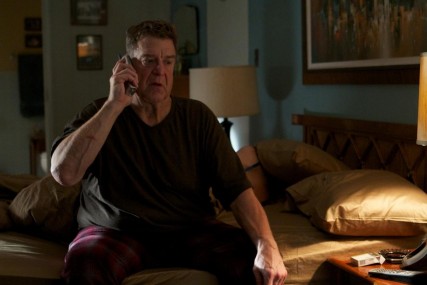
"What's that, sir? Time for pointless exposition?"
Things go from tense to worse quickly as the Cooper clan’s late night revival goes haywire, leading to a body count that includes an officer, inciting the rage of a new character, an ATF agent named Keenan and played by John Goodman. This is also where the movie has it’s first stumble as the introduction of Goodman is used as an excuse for an extended scene of exposition as he talks via bluetooth to his superiors, going over their surveillance of the Cooper gang over the past few years. This is followed by a chase scene through the church that is a perfect example of how good Kevin Smith could be as a director, but also how much more he needs to learn. As the escapee is fleeing through the church, the camera following him is bobbing around, bouncing off walls in a fashion as frantic as the character certainly feels. Chasing behind him is a group of church members, doggedly pursuing him through the dungeon-like depths of the temple. The unfortunate mistake that Smith makes here is that he uses the same, bouncing camera angles for the shots of the chasers. This is a big mistake, and one that he should have noticed, as it subconsciously puts both the chasers and the one being chased in the same mindset for the viewer. This is a mistake that mars an otherwise brilliantly frantic scene. Interestingly, this also marks where the movie has a jarring and ultimately catastrophic stumble.
SPOILER ALERT: For me to go on discussing this movie, I am going to need to give a pretty major spoiler here. So be forewarned, if you read any further, I will be discussing major spoilers and the end of the movie.
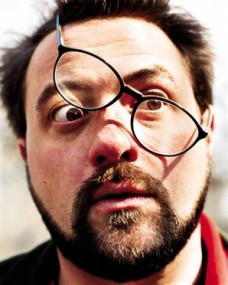
And now for the fall
Halfway through the movie, Smith kills the main character. The kid runs out of the house and is gunned down by the trigger happy sheriff who is standing with the ATF at the front gate. I respect what Kevin Smith thought he was doing here, but it is done sloppily and with no good reason. Bear with me as I take you through this set up.
One of horror’s most iconic films has always been Psycho. In the original, the main character is famously murdered in a shower halfway through the movie, sending the viewer into a tailspin as you have no clue what Hitchcock has up his sleeve anymore. The main character is supposed to LIVE! This sense of confusion is what Smith was going for here, but there is one thing that he failed to handle. You see, Janet Leigh was never the main character of Psycho. Sure, normal film conventions had us tricked into thinking she was our heroin, but we were clearly more invested in the character of Norman Bates. Once Leigh dies, we are plunged willingly (and ‘willingly’ is the key word here) into Bates’ psychosis as he struggles to deal with what “mother” has done. You see, Bates was always our main character, we had just been fooled into thinking that we were interested in Leigh’s story. In Red State, Smith attempts to jar us with the death of the main character, but instead of effectively changing our focus, he leaves us dangling. Once the main character is dead, who are we supposed to be interested in? Hell, in this age of movies we don’t even have to be saddled with a righteous, honorable hero to carry us through the movie, but we at the very least have to be given someone we care about! Here we are left with only two options: the evil pastor, Abin Cooper (played brilliantly by Michael Parks) or the ATF agent who has spent the majority of time on screen talking on a cell phone (played oddly effectively by John Goodman, a testament to his acting prowess for certain.) Neither of these characters qualify as our focal point, and so we are left without an anchor in this movie, and for the remaining 40 minutes we are going to have to settle into the idea that this is a whole new story.
Something else happens the moment you kill our main character: the movie resets for us. This means that the viewer will become overly critical of what they are watching, just like they are for the first ten minutes. Unfortunately, Smith throws in one of the worst plot points of the movie here as the ATF agents make the ludicrous decision to murder everyone in the home, going so far as to force a twenty year old girl to walk back into the house so they can shoot her in the back of the head before they kill the children she was taking care of. I understand that Smith is trying to draw comparisons to the Waco massacre, but this scene is so far out of bounds I just can’t go along with it.
One of the three kids from the beginning is still alive, and teams up with the girl from the compound that wanted to save the children. We’re supposed to care about these two, possibly even get suckered into thinking we’re going to ride the rest of the movie out with them, but we already know better, and these two are dead before we ever get a chance to know them. In his mad scramble to keep us on the edge of our seats, Smith forgot to make sure we were still in our seats and not already leaving the theater.
And then there’s the ending. I had heard it was bad, but I wasn’t prepared for this! The trumpets of God call out, and the members of the church come out with arms raised, ready for the return of Jesus. The ATF confronts them, then we cut to a courtroom scene of Goodman’s character giving us an EXPOSITION of what happened at the scene! Can you believe that?! Exposition is the first sin of movie making, and this movie ends with an exposition of everything that happened at the end. Horrible. A lot of people complain about the explanation of the fog horn, but I would contend that this part could have been brilliant. You see, the problem with explaining away the trumpets of God as being an old siren that some marijuana farmers had installed to screw with the Cooper gang is that we feel cheated when the explanation is given. We feel cheated because this plot point was never set up earlier in the movie, meaning that when we are given the explanation it comes from absolutely no where (this is known as a Deus Ex Machina.) The right way to have gotten away with this would have been to insert a scene earlier in the movie where the marijuana growers are introduced, perhaps complaining to the sheriff about the Coopers. Smith could have deftly inserted a line early in the movie about how these guys were going to have to take matters into their own hands, but he never bothers to set this one up, so the explanation falls flat with the viewer. It’s a shame, as it could have been a fun way to end the movie to have a couple potheads sitting on top of their house laughing as the siren wails.
All in all, despite the problems this movie is plagued with, I think this is Smith’s best movie to date. It certainly is not his most FUN movie, and I doubt I’ll watch it again (whereas I have seen Clerks at least ten times), but there were glimmers of true film making to be seen here, and I think it’s a shame that Smith has declared that he has no interest in making films again. He clearly inspired fantastic performances out of his cast (they were truly fantastic), and the camera felt far more alive here than anything else he has directed. Red State was his closest step yet in the direction of becoming a good film maker, but he seems content being relegated to those dark closets in our minds, laughing as he smokes a joint.

Pingback: comment soigner une sciatique()