






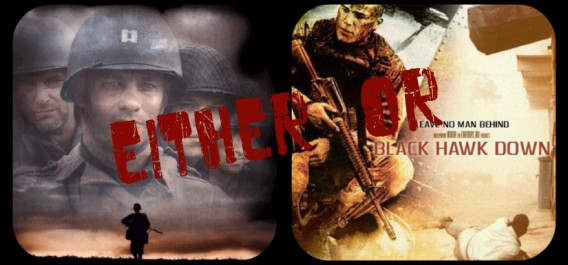
Which movie is better?
War movies are like crack for me – if smoking crack made me weepy and jingoistic. I’ve never been in the military, and the few guns I’ve ever shot did more damage to me then anything I was aiming at. I know next to nothing about defending my country (or being a pawn led into deadly situations to help rich people get more oil, but I digress) and the extent of my heroics involve carrying in ALL of the groceries from the trunk to the kitchen in one trip. Yet even still, I would happily watch a two day long war movie marathon with nothing other then a bedpan and a bag of sliders by my side. Don’t test me! I just finished watching two of my all time favorite war movies, Saving Private Ryan and Black Hawk Down. Today, I’m going to break these movies down and decide which one is better. Join me as I delve deep into the minutia of these flicks and spend far more time debating their virtues than is healthy.
THE OPENING
Let’s start with Black Hawk Down (BHD) since Saving Private Ryan (SPR) has a legendary opening that wins this face off immediately. BHD’s first fifteen minutes are bad – please don’t hate me for saying it, and understand that this is one of my favorite movies of all time, but I’m putting my critic’s hat on here, and BHD’s opening is clumsy, unnecessary, and commits one of the biggest cinematic sins possible. Ridley Scott decided to start the movie with text. To his credit, he doesn’t throw up a paragraph onto the screen like so many other, less inventive directors have done a hundred times before. Instead, he gives us a series of sentences broken up by scenes of the residents of Mogadishu (the setting for the movie) living in the hell that the movie’s bad guy, a vicious Somali warlord, imposed upon them.
The text tells us the story of how this warlord has been terrorizing his people, and how the United Nations has been powerless to stop him. Since this is a true story it was necessary to give us a massive amount of information quickly to bring us into the story, but I don’t think text is the right way to do it. The most frustrating part for me about the start of this movie is how we go from an info dump of text into a scene that could have been stripped from the movie without anyone having noticed. The United States is tracking a shady weapons dealer through Mogadishu, then kidnaps him in an attempt to learn the location of the Somali Warlord they came for. We are given a weak interrogation scene that is plunked into the middle of a time in the movie that should have been reserved for character development. Instead of being given time to get to know our heroes, we are forced to focus on this arms dealer who will soon disappear from the movie entirely, never to return. This was a mistake, and it is going to have an affect on our enjoyment of the movie – we’ll get there soon enough.
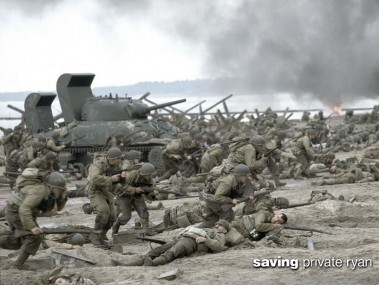
One of the greatest openings of all time
SPR has a legendary opening. Not only is storming the beaches of Normandy one of the single most epic and well known battles of all time, but the intense nature of SPR’s first twenty minutes is a piece of film legend. I will listen to NO arguments to the contrary – SPR’s beginning is one of the most intense pieces of war-film footage ever captured. We are introduced to our main character, and ONLY our main character. He charges across the beach as we are forced to see what he sees, and we are left to ponder if this is what it was really like. Eventually I think we all came to the same realization: The real thing was even worse, and that is terrifying. Tom Hanks eventually begins to meet up with some of the other characters that are going to be sticking with us, but the brilliance of this beginning is how the first time you saw the movie, you had no idea who was going to walk away alive from this battle. You might think you recognize an actor here and there, but the carnage across that beach is so complete and unforgiving that no one is safe. By the time the soldiers have firebombed the bunkers at the head of that beach, we are left emotionally exhausted, and as Tom Hanks gazes out over the destruction we can sense every thought.
SPR suffers some criticism for the very beginning of the movie, in which we see an old man visiting the graves of his compatriots while his family walks along with him. The camera zooms into his blue eyes, and Steven Spielberg tricks us into thinking that the old man is supposed to represent Tom Hanks in his old age – something that helps to make his eventual demise more affecting. While I agree this is a trick, it is not one that we can blame Steve for, since it is our own perception that tricks us. I’ve heard people say that the camera zooms into the old man’s eye, and then out of Tom Hank’s eye, but that’s not what happens. It’s interesting that people remember it this way, since the film isn’t that devious, but instead starts from a view of the entire boat that Hanks is on. It could be argued that Private Ryan, the character who is the actual old man from the beginning, parachuted into Normandy, which would mean that zooming into his eye implies he also saw the events on the beach, which he wouldn’t have, but I think that’s splitting hairs. The beginning of this movie is as good as it gets.
THE CHARACTERS
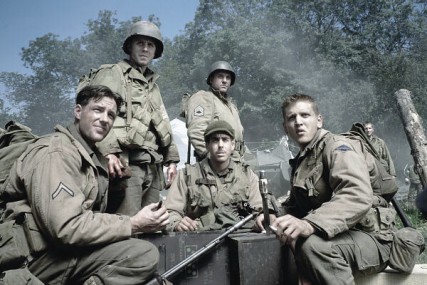
Great cast, better characters
This is another category SPR wins hands down. One of the hardest parts about filming a war movie is creating a cast of characters that are easy for the viewer to distinguish. You see, all of the characters are going to be wearing standard issue uniforms for much of the film. They all look alike! How is the viewer supposed to grow attached to a character when they can’t tell them apart from the other ten guys standing around shooting at things next to them? Spielberg knew this, and he cast the movie brilliantly. Each of his characters stand out from one another so completely that I have to sit back and applaud. I was never confused about who was where, who was shot, who was shooting. This was in part because of the directing, but it was also because of the casting. These guys all stood out, and we were given an opportunity to relate to one or another at some point.
BHD suffers terribly in the character department. There are a few actors that stand out, like Eric Bana, Ewan McGregor, Josh Hartnett, and Tom Sizemore (who plays practically the same character in SPR as well) but the cast here is massive, and the majority of their buzz cut heads look exactly like that of the guy standing next to them. I’ve watched this movie at least 30 times, and probably more (I told you, I LOVE this movie), yet every time I watch it I notice a connection that I should have seen the first time. Many of these kids look so much like one another that the only way to tell them apart is if you memorize their names, that way you can recognize when the guy that just got shot was also the guy that was playing basketball earlier. If this movie had been so jam packed with action that they just couldn’t have fit in any character development that would have helped me relate to these soldiers better, then I could forgive it, but I keep getting brought back to that first fifteen minutes where I was forced to watch a pointless interrogation scene. If that time had been better spent introducing me to the characters, then I wouldn’t have had to watch it 10 times to start understanding who was getting shot and who was walking out alive. It’s true that the movie tried to give each of the multitudes of characters a scene of introduction, but seeing two characters discuss a charcoal drawing from a children’s book isn’t enough to make me remember their arc an hour down the road as the bullets are flying.
To prove my point, I’ll recount a very emotional scene, where a soldier calls home in hopes of reaching his wife before heading out on the mission that will ultimately claim many of their lives. He gets the answering machine, and leaves a message while we watch from inside his home as his wife comes in with groceries just as he hangs up. This is a great scene, and it sticks with you. Now, I ask you, what soldier was it that called his wife? Do you know? Because I don’t. Maybe I’ll pick that up the 31st time I watch the movie.
THE PLOT
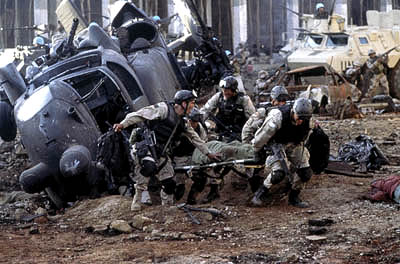
This shit really happened!
Finally, BHD wins a round! BHD recounts a true story, and from what I have read and watched about the actual event, the movie does a pretty damn good job of relating what really happened. That gives it a hell of an advantage over SPR, where we are given a plausible, yet fictional story stuck into a historic setting. Many people, especially screen writers, would decry my opinion that a true story is more affecting than a fictional one, but it’s true. As I watch BHD, I can’t help but shake my head and marvel at the fact that this really happened! In fact, that’s a big part of why the beginning of SPR is so intense, because we all know this actually happened, and watching it is like being given a window into one of the most intense and horrific scenes that has ever taken place. You can yell at me all you want about how unfair it is to give true stories a leg up over a well written fictional one, but that doesn’t change the emotions that I feel as the movie plays. For this reason, BHD wins this round.
The plot of a war film is almost always just a series of paperclips connecting battle scenes. SPR works harder at creating a storyline as Hanks and his crew march through German infested lands in search of the last living Ryan boy, while BHD simply gives us a reason for an unending series of shootouts with rare moments of reprieve to regroup, reload, and watch a character bleed out. Despite how hard SPR works at telling us a story, BHD’s simplicity is ultimately what wins the day. These soldiers are sent into a mission gone wrong, and they are then left to pick up the pieces. They are in a sea of enemies, with no help in sight, and we can feel the crushing weight of their demise as the wall of ‘Skinny’s’ descends upon them. The heroics we see, as men that were hovering safely above or back at the base decide to charge back in to save their brothers in arms, is perhaps one of the greatest war stories ever told. And it really fucking happened. BHD wins.
THE BATTLES
These are war films, so the WAR had better be good! One might expect the winner of this section to be SPR given how legendary the opening 20 minutes has become. Yet I disagree. To me, the battles in BHD are far more intense and fascinating than SPR. Part of it is because of my age, and how close to reality BHD feels. The kids in this war are my age, and that makes a big difference to me, which I’ll admit is far too subjective, but despite this, I would still argue that the battles in BHD are superior to SPR.
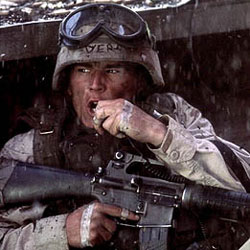
Did we win yet?
Spielberg made a decision when filming SPR that he would use a grainy filmstock to attempt to help the movie feel as if it were of a certain age. It worked, and the sepia tone helps transport me to a certain time period. The negative side effect of this decision, however, is that the action feels somewhat removed. When someone gets shot in SPR, sometimes the blood is red and disgusting, and sometimes it is black and viscous, like the tin man just sprung a leak. The blood in BHD bursts forth in brilliant red displays of gore, and every bullet that strikes a wall creates a burst of dust that I see every detail of. BHD is exhilarating.
There is one scene in SPR that nearly gave it an edge in this battle. When the German soldier drives that knife into the chest of Stanley Mellish as our soldier begs him to stop, I felt like I was dying on that cold, wooden floor with him. It is a scene that has stuck with me ever since my first time seeing the movie, and I feel like I witnessed something that I shouldn’t have, which is ultimately what a war film is supposed to make us feel. Because of this scene, it was hard to make a decision about which movie wins this round, but BHD squeaks out the win.
THE ENDING
SPR makes some mistakes at the end. I know many of us are emotionally invested in the demise of Hanks’ character on that bridge, and listening to someone debase it is going to feel pretty dirty, but bear with me here. Earlier in the movie, one of the characters had convinced Hanks to show mercy to a German soldier. They let the man live, much to the distaste of the other men in their crew. At the end of the film, as Hanks is nearing the finale of his mission, this German soldier shows back up, and he ends up being the one to fire the bullet that will end our hero’s life. I hated this. It’s far too convenient, and it feels too much like a script. It’s enough that this German soldier joined back with the Nazis and ended up at this particular battle, but to have him fire the shot that mortally wounds our main character is a bit too melodramatic for my taste.
Hanks sacrifices himself to complete his mission, and as he lays on that bridge with his gun drawn and the tank rolling slowly forward, we become suddenly aware that this movie isn’t going to let him go back to being a school teacher. He’s going to die here. He aims his pistol and fires at the tank, the bullets ricochet off feebly. Then a miracle happens, and the tank erupts in a fireball, leaving us with a pause just long enough to contemplate, like Hanks himself does, if his bullets had somehow destroyed a tank. Then the plane comes flying overhead and we realize that a bomb was responsible. Here again we’re given a scene that feels far too scripted, and it comes so close on the heels of another equally Hollywood moment that everything starts to feel a little too tidy.
Then comes the death speech. Maybe by this point you are expecting me to shit all over this too, since I’ve just lambasted the last ten minutes of the film, but you’d be wrong. I care enough about this character that hearing his final words is cathartic. I lean forward in my seat as he struggles to say the words, his body slowly giving in to death. “Earn this,” he says as he clutches Ryan’s shirt. Then he passes, and we are transported back to the present, where the old man is kneeling at the grave. The old man asks his wife to tell him that he lived a good life, and she tells him he did. Then we are left with a vision of a waving flag as the movie ends (a scene that irked a lot of non-Americans, but I loved it, because I’m Proud To Be An American!!)
Now let’s look at BHD. Here we have a case of a movie that just doesn’t know when to end. It’s frustrating, because we have three perfectly good endings to the movie, but instead of just picking one of them, they gave us all three. First, we watch as the soldiers run along side the convoy back to base. It is a gorgeous shot of the men running along as the residents of Mogadishu gather around, laughing at them and making rude gestures as they pass. This is a poignant scene, and it encapsulates everything that the movie was trying to say. We weren’t wanted here, and the men that were forced into this battle shouldn’t have been there. The cinematography is beautiful. The music is perfect. The emotions I feel are exactly what the director intended. The movie should have ended here.
But it doesn’t. Next we see some soldiers gearing up to head back into battle, and Josh Hartnett confronts Eric Bana. Why would he go back out there after what they had been through? Bana gives a tremendous speech about what it means to be at war. He explains how picking up a gun and charging into battle has nothing to do with being a hero; it has nothing to do with following orders; and it sure as shit doesn’t have anything to do with appeasing the men in suits that sent them there. The reason you strap on a gun and go to war is because of the brothers that are there beside you. And he’s not about to leave them behind. WOW! What a great way to end the movie! Roll the credits, because we’re done here. Great ending.
But it’s not over. Finally we are given a scene with Josh Hartnett explaining to an unseen person what he thinks about war, and why he’s there. It’s not a bad speech, and it is made more poignant when we see that he is giving it in a morgue, to his dead friend (damn I wish they’d given us more time to get personally involved with the relationship these two had – it wouldn’t have taken much time, maybe just about the same amount of time it took to interrogate a useless character!!!!) I don’t mind the ending, any of them! But I wish they would have just let the credits roll after the first one.
So we’ve come to decision time. If you haven’t been keeping track, these two movies are tied right now. SPR won the Opening and the Character, while BHD won the Plot and the Battles. They’re tied up, 2 to 2, so it all comes down to which movie had the better ending.
Drum roll please…

Earn this.
Saving Private Ryan is our winner. I know, I know, it seemed like I was dogging the end of SPR pretty bad earlier, and it’s true that I have some major problems with the way things are resolved, but there is something here that is far more important, especially in a war film: The Characters!
You see, I care about the story arc of every single one of the characters in SPR, and I want to see the way each of these stories end. Since this is a war film, the basic story arc that is being completed is the death or survival of the characters, and I can tell you exactly who lives and who dies. There’s no need to watch the movie ten times to figure it out – I KNOW! I knew the very first time I saw it, because I cared about every single one of them. When Hanks turns to look at Sizemore and realizes he has died, I feel just as shocked and saddened as he does.
And finally, as Hanks grabs a hold of Private Ryan’s collar and pulls him in close, I understand that he is talking to me. That is the brilliance of this movie, and I want each and every one of you reading this to take a moment to recognize it. As Hanks says, “Earn this,” he’s not talking only to Ryan. He’s talking to YOU. 417,000 American soldiers were killed in World War 2. They died to help save the world from a tyranny that had never been equaled before or after. They died for you and I, and as this character says, “Earn this,” the script is reaching out, breaking down the fourth wall in a way that is heartbreaking and sincere. Have you earned their sacrifice? As Ryan asks his wife if he’s lived a good life, don’t we all sit back and wonder the same thing about ourselves?
So yeah, Saving Private Ryan wins. Hands down.
Pingback: money()